

Blocked artery in the leg: calf pain when walking, the tests, stent or bypass
Calf pain that always appears after the same distance and goes away within a few minutes of rest is the first sign of a blocked artery in the leg. Here is how the diagnosis is made, what it says about your heart, and when an operation is genuinely discussed.
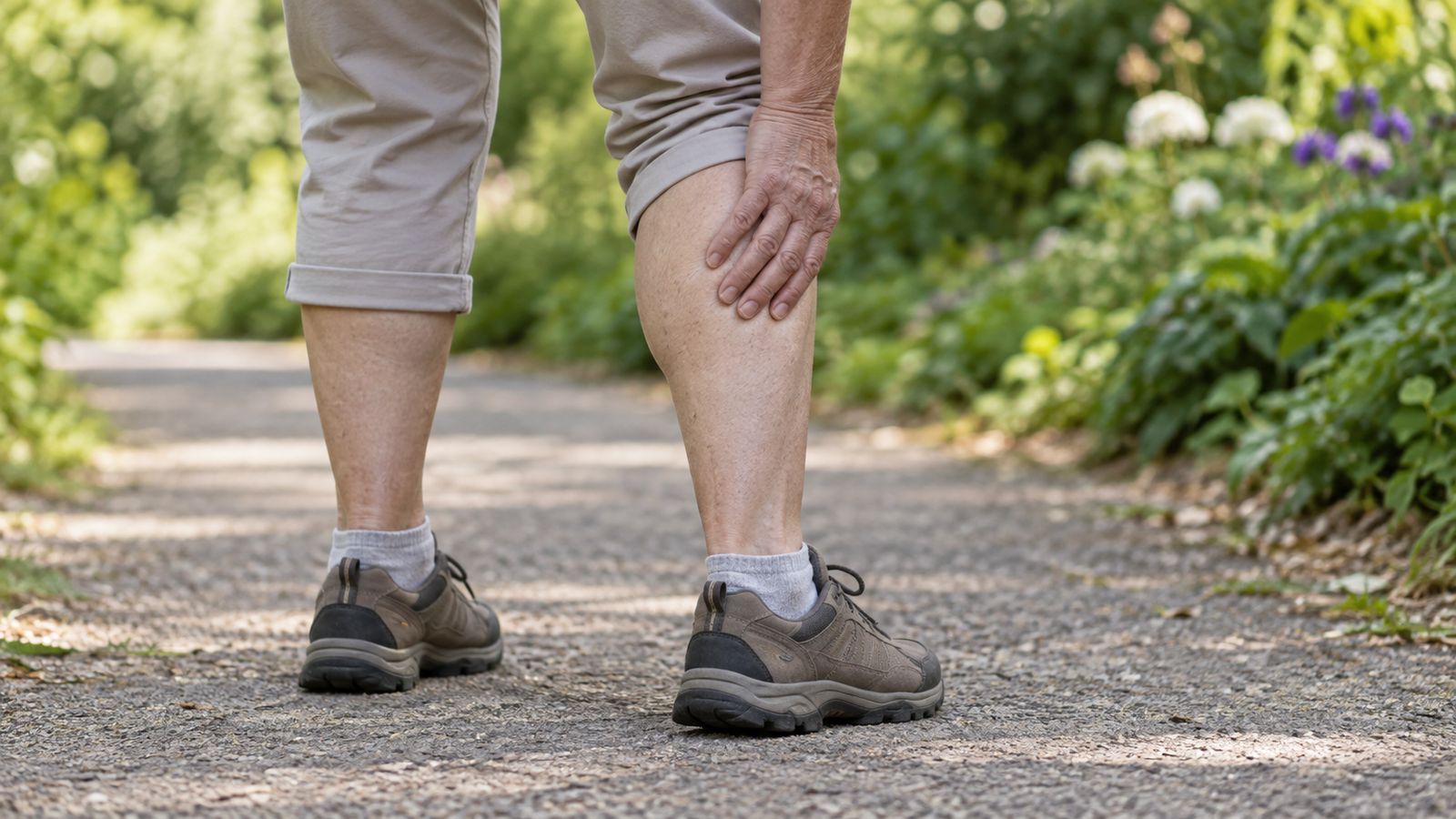
You are walking, and after one hundred, two hundred or five hundred metres, the calf tightens like a cramp. You stop, the pain passes in a minute or two, you set off again, and it comes back at roughly the same distance. This pattern has a name, intermittent claudication, and it most often signals a narrowed or blocked artery in the leg. It is the same mechanism as in the arteries of the heart: a cholesterol plaque that narrows the passage of blood. The diagnosis rests on a clinical examination and pressure measurements, completed if necessary by a duplex ultrasound. Here is what it says about the rest of your arteries, and when an operation is genuinely discussed.
Key figures
- 236.6 million
- People aged 25 and over were living with peripheral arterial disease of the lower limbs worldwide in 2015, nearly three in four of them in low- and middle-income countries. The Lancet Global Health, 2019
- 20 to 59%
- Of patients with proven disease feel no leg pain at all: their walking shrinks without anyone making the connection. AHA / ACC, 2024
- 32,4 %
- In 370 Moroccan patients at high cardiovascular risk screened at the CHU in Marrakech, the ankle-brachial index found peripheral arterial disease, silent in 77.5% of cases. Journal des Maladies Vasculaires, 2016
- +120 m
- Of maximum walking distance gained through a supervised walking programme, with no operation at all. Cochrane, 2017
What a blocked artery in the leg is
The arteries of the legs come off the aorta, divide at the pelvis, pass through the groin, behind the knee, then on towards the foot. In 90 to 95% of cases, what blocks them is a cholesterol plaque laid down on the artery wall, exactly as in the arteries of the heart. Blood still gets through at rest, but no longer enough when the muscle asks for more, when you walk. Hence the pain that appears on exertion and fades as soon as you stop.
Four factors weigh the heaviest. Smoking first: in smokers, the risk of developing the disease is almost three times higher in high-income countries. Then diabetes, which multiplies the risk by seven according to the Assurance Maladie, and above all the risk of amputation. Then high blood pressure, which multiplies the risk by 2.5, and excess cholesterol. In Morocco, the national STEPS survey by the Ministry of Health shows the scale of the problem: 29.3% of adults have high blood pressure, 10.6% have diabetes, and 23.4% of men smoke.
The sign that should alert you: calf pain when walking
Intermittent claudication has precise features that set it apart from back pain or joint pain:
- It comes on when walking, often sooner uphill or when walking fast, never at rest.
- It affects the calf most often, sometimes the thigh or the buttock depending on which artery is involved.
- It goes away when you stop, in less than ten minutes, usually in one to three minutes.
- It comes back at roughly the same distance, what the doctor calls your walking distance.
Other signs often go with the picture, and are easily put down to age: shiny, dry skin, hair loss on the leg, nails that thicken, a cold foot, a small wound that is slow to heal, sometimes erection problems. And there is one counter-intuitive point to remember: between 20 and 59% of patients with proven disease have no pain at all. Many have simply cut down their walking, without saying so.
When the disease gets worse: pain at rest and a wound that will not heal
A more severe stage exists, called chronic limb-threatening ischaemia. It shows itself as a burning pain in the foot at night, which forces you to hang the leg out of the bed to get relief, then as a wound that does not heal or gangrene of a toe. The Assurance Maladie considers that such pain lasting more than fifteen days points to worsening. This stage is not the inevitable end of claudication: it affects a minority of patients, but it is the one that truly threatens the limb, and it warrants prompt advice.
Six signs that mean calling the emergency services
A leg artery can also block suddenly, because of a clot. English-speaking medicine sums up the signs with six words beginning with P, easy to remember:
- Sudden, intense pain in the leg (pain).
- Pale skin (pallor).
- No pulse (pulselessness).
- A cold limb (poikilothermia).
- Pins and needles or loss of feeling (paresthesia).
- Being unable to move the foot (paralysis).
With this picture, every hour counts to save the leg: the Haute Autorité de Santé states that no test should delay treatment. Call 141 (SAMU) or 15 (Civil Protection) without waiting.

The diagnosis comes down to a blood pressure cuff
The reference test is simple, painless and involves no radiation: the ankle-brachial index. The pressure is measured at the ankle and at the arm, then divided. The thresholds are the same everywhere:
- 0.90 or less: the diagnosis of peripheral arterial disease is made.
- Between 1.00 and 1.40: normal.
- Above 1.40: arteries that cannot be compressed, common in people with diabetes and in people with kidney failure. The pressure is then measured at the big toe.
The test takes up to an hour and involves no needle and no side effects. If it is abnormal, an arterial duplex ultrasound locates and measures the narrowings. A CT angiogram or an MR angiogram come only afterwards, when a procedure is being considered.
Why a leg artery also tells you about your heart
This is the point patients often discover at a consultation: a blocked artery in the leg is a signal about the whole arterial network. In the international REACH registry, which followed more than 68,000 patients in 44 countries, 5.35% of those with peripheral arterial disease of the legs had a heart attack or a stroke, or died of a cardiovascular cause, in a single year. Counting hospital admissions for an arterial event, that figure rises to 21.14%. And up to 45% of patients with known arterial disease have more than one area affected.
That is why the 2024 European guidelines ask for the whole network to be examined, heart and carotid arteries included, in these patients. A carotid duplex ultrasound is often part of that work-up.
Read also: preventing stroke and screening for carotid stenosis
Cardiology consultation in Tangier: heart check-up, review of your tests and a second opinion
The treatment that works best of all: walking
The first surprise, for many, is that the reference treatment for difficulty walking is walking itself, supervised. The 2024 European guidelines place it at the highest level of evidence: three 30-minute sessions a week for at least three months, preferably supervised. The UK NHS speaks of two hours a week for three months, the Haute Autorité de Santé of three one-hour sessions. The principle is always the same: walk until the pain comes, stop, set off again.
The benefit has been measured. A Cochrane review of 32 trials and 1,835 participants finds, compared with no exercise, 82 metres gained before the pain appears and 120 metres on maximum walking distance, with an effect maintained for up to two years. The ankle-brachial index itself does not change: it is the muscles and the collateral circulation that adapt.
Stopping smoking comes at the same level. According to the Cleveland Clinic, out of a hundred people who stop smoking after the diagnosis, about 86 are still alive five years later, compared with 69 among those who carry on.
Read also: 7 habits to protect your heart
The medicines that protect the leg and the rest of you
Medical treatment does not target the leg alone, it targets heart attack and stroke. It rests on an antiplatelet, low-dose aspirin or clopidogrel, and on a statin with a demanding target, an LDL cholesterol below 0.55 g/l and reduced by at least half. To this are added blood pressure control, with a target of 120 to 129 mmHg systolic in most patients, and diabetes control.
In patients at high risk and without particular bleeding risk, adding a small dose of anticoagulant, rivaroxaban 2.5 mg twice a day, to aspirin reduces cardiovascular events. In the COMPASS trial, in 7,470 patients, these occurred in 5% of patients on the combination versus 7% on aspirin alone, and serious events affecting the limb were halved, at the cost of slightly more bleeding. This decision is made case by case with your doctor.

Stent or bypass: when an operation is discussed
For difficulty walking, an operation is not the first response. The Haute Autorité de Santé reserves revascularisation for claudication that remains disabling after at least three months of well-conducted medical treatment. The 2024 American guidelines are clearer still: they advise against operating on a patient who is responding well to medical treatment, and against doing it for the sole purpose of slowing the disease. In chronic limb-threatening ischaemia, on the other hand, revascularisation becomes urgent to save the limb.
When a procedure is decided on, there are two routes. The endovascular route, through a small catheter, widens the artery with a balloon and sometimes places a stent in it: this is the effective treatment for lesions in the pelvis and the thigh, often as a day case. Its weak point is the narrowing coming back, which happens in about 30% of cases within three to twelve months. Surgery, for its part, goes around the obstacle with a bypass, as for the arteries of the heart, using one of the patient's own veins or a prosthetic graft.
Two large recent trials are often quoted, and it must be said straight away that they are not about simple difficulty walking: they were run at the stage of chronic limb-threatening ischaemia, when the limb is under threat. Their conclusions differ. BEST-CLI, published in 2022 in 1,830 patients, shows that where a good saphenous vein is available, surgery does better than the endovascular route: 42.6% major events or deaths versus 57.4%. BASIL-2, published in 2023 on lesions below the knee in more fragile patients, goes the other way and favours the endovascular route as first-line treatment. These results therefore do not carry over to claudication.
The choice of graft, for its part, comes from other work. When a bypass to the popliteal artery is decided on, the 2024 American guidelines favour one of the patient's own veins rather than a prosthetic graft, at their highest level of recommendation.
The leg bypass in practice
The information leaflets from UK hospitals give concrete benchmarks, useful for organising your life around the operation:
- The hospital stay lasts three to seven days depending on the team, with getting up into a chair from the next day.
- The operated leg swells, and that swelling usually lasts two to three months. Numb patches around the scar are common and most often settle.
- Driving becomes possible again when an emergency stop is safe, usually two to four weeks after the operation. Going back to work falls between six and twelve weeks depending on the job.
- An antiplatelet is prescribed on discharge and is continued long term to stop the bypass blocking.
- Monitoring is by duplex ultrasound, within one to three months, then at six and twelve months, then every year: the aim is to spot a narrowing before it blocks the bypass.
- Walking damages neither the bypass nor the scar.
Like all arterial surgery, it carries risks, which the surgical team puts in figures for each patient according to their heart, lungs and kidneys. Infection of the prosthetic graft is rare, of the order of 1 case in 500, but serious. The most common complication remains blockage of the bypass, which often calls for a further operation. After the operation, sudden pain, a cold foot or new numbness mean contacting the care team immediately.
When the blockage sits in the aorta and the arteries of the pelvis, the procedure is an aortobifemoral bypass. The Cleveland Clinic gives an operation of two to six hours, four to seven days in hospital, a return to normal activities in four to six weeks and full recovery in two to three months. Between 80 and 95% of these bypasses are still improving the circulation five years later, and 74 to 86% at ten years.
Dr Tber, a cardiovascular surgeon in Tangier, manages these situations with his team at the Clinique Riad Marshan, from assessment at a consultation to surgery when it becomes necessary.
The risk of amputation, without dramatising it
This is the fear that dominates as soon as leg arteries are mentioned, and it deserves a measured answer. For simple difficulty walking, progression to a serious stage is in no way automatic: international guidelines point out that it cannot be predicted and that most patients stabilise on medical treatment. The risk is concentrated at the stage of chronic limb-threatening ischaemia, where the rate of major amputation at one year reaches up to 30%, and up to 35% when there is a wound or gangrene, compared with less than 10% when there is only pain at rest. Diabetes multiplies this risk, with a hazard ratio for amputation of 5.5 in the 2024 American data.
Two practical conclusions follow. The first: a foot wound that does not heal, in someone with diabetes or a smoker, is never trivial. The second: the French guidelines insist on preserving the knee whenever that is possible, because it completely changes how walking is regained.
Protecting your feet, especially when you have diabetes
The 2024 American guidelines place foot care at the highest level: learning to inspect your feet yourself, having them examined at every consultation, and fully at least once a year, and wearing suitable shoes if you are at high risk. To this are added the measures that protect all the arteries: stopping smoking, a Mediterranean-style diet rich in pulses and fibre, control of diabetes, blood pressure and cholesterol, and walking every day.
On how common this disease is in Morocco, the sources consulted do not allow a representative national estimate. The only local work found, carried out at the CHU Mohammed VI in Marrakech in 370 patients at high cardiovascular risk, found peripheral arterial disease in 32.4% of them, silent in more than three cases out of four. That is a good reason to measure the ankle-brachial index during a check-up, when age, diabetes, blood pressure and smoking add up, even with no pain at all.
Frequently asked questions
How do I know if an artery in my leg is blocked?
Does calf pain when walking always come from the arteries?
Does a blocked artery in the leg need an operation?
Stent or bypass, which is better?
How long does recovery take after a leg bypass?
Am I at risk of amputation?
Does a blocked artery in the leg mean my heart is diseased?
Sources and references
External resources, opened in a new tab.
- Peripheral arterial disease of the lower limbs: definition, causes, symptoms and treatment Assurance Maladie (ameli.fr)
- Management of chronic atherosclerotic peripheral arterial disease of the lower limbs Haute Autorité de Santé
- Guideline for the Management of Lower Extremity Peripheral Artery Disease, 2024 American Heart Association / American College of Cardiology
- Global, regional, and national prevalence and risk factors for peripheral artery disease The Lancet Global Health, 2019
- Screening for peripheral arterial disease with the ankle-brachial index in high-risk Moroccan patients Journal des Maladies Vasculaires, CHU Mohammed VI, Marrakech, 2016
- Exercise for intermittent claudication (systematic review) Cochrane, 2017
- Low-dose rivaroxaban in peripheral arterial disease (COMPASS) The Lancet, 2018
- Surgery or endovascular treatment in chronic limb-threatening ischaemia (BEST-CLI) New England Journal of Medicine, 2022
- Vein bypass or endovascular treatment as first-line therapy (BASIL-2) The Lancet, 2023
- Leg artery bypass (fem-pop bypass), patient information University Hospital Southampton NHS
- Peripheral arterial disease (PAD) NHS
- Aortobifemoral bypass Cleveland Clinic
Readable also
On the blog
Normal, fast or irregular heart rate: when should you see a doctor?
A racing heart is not necessarily a sick heart, and a calm pulse is not always reassuring. Here is how to tell what is normal, what deserves a consultation and what calls for emergency help.
Read
Cardiologist or cardiac surgeon in Tangier: who should you see, and when?
Both look after the heart, but they come in at different stages. Here is how to know which one to turn to, and why most patients end up seeing both.
Read