

Aortic aneurysm: understanding a silent disease, and getting screened for it in Tangier
An aortic aneurysm often develops without a single sign, until it becomes dangerous. Understanding what causes it, how it is screened for and how it is treated is what lets you act in time, and calmly.
Written by Dr Mohamed el Amine Tber, cardiovascular surgeon in Tangier
Theaorta aneurysm is one of the most insidious cardiovascular conditions: it usually develops without the slightest symptom, sometimes for years, before announcing itself all at once. The aorta is the body's largest artery: it leaves the heart and carries oxygenated blood to the whole body. When part of its wall weakens, it widens in that spot and forms a permanent bulge, the aneurysm. Properly understood and monitored in time, it can be treated in a planned, safe way. That is what this article is for, written for you by Dr Tber's practice in Tangier.
Key figures
- 85 %
- About 85 people in 100 whose aneurysm ruptures do not survive. NHS England
- 4 times
- Men are affected by abdominal aortic aneurysm four times as often as women. NHS England
- 2 mm a year
- This is the average growth of a small aneurysm, slightly faster in smokers. British Journal of Surgery, 2011
- 55 mm
- This is the diameter from which repair is discussed in men, 50 mm in women. European Society for Vascular Surgery, 2024
What is an aortic aneurysm?
We speak of an aneurysm when the diameter of the aorta increases abnormally and permanently, generally beyond 1.5 times its usual calibre. This widening can affect two main regions:
- The abdominal aorta (at the stomach): this is the most common location.
- The thoracic aorta (in the chest, close to the heart): less common, but calling for particular attention.
The danger does not come from the bulge itself, but from its tendency to grow slowly over time. The wider it gets, the thinner the wall becomes and the higher the risk of complications. That is why an aneurysm found early, even a small one, deserves regular follow-up.
Causes and risk factors
Weakening of the aortic wall usually results from a combination of factors acting over years. The main ones are:
- Smoking : this is the single most important risk factor, and the most avoidable one, particularly for the abdominal aorta.
- The advanced age The risk increases significantly after 65 years.
- Male Men are more often involved than women.
- High blood pressure : high pressure is arousing and weakening the wall of the aorta on a daily basis.
- Atherosclerosis and excess cholesterol, which alters the arteries.
- Family history aneurysm or aortic dissection.
- Some connective tissue diseases, such as Marfan or Loeys-Dietz syndrome, which often affect younger patients.
Smoking weighs heavily: current smokers have about five times the risk of non-smokers, and former smokers still have double the risk. A bicuspid aortic valve is also associated with widening of the thoracic aorta.
Read also: aortic stenosis, when is surgery needed
Symptoms often absent: silent disease
The great majority of aneurysms cause no signs at all. They are often found by chance, on an abdominal ultrasound or a CT scan done for something else. That absence of symptoms is exactly why screening matters so much.
When signs appear, they may include:
- a feeling of beating or pulsating in the abdomen;
- deaf and persistent back, belly or flank pain;
- chest discomfort for aneurysms located near the heart.
Feeling your aorta beat in your belly is not always abnormal: in a slim person, it is common when lying down. A pulsating mass that feels wide, however, especially in a man over 65 who has smoked, calls for an ultrasound scan.
Alarm signal to be known: a sudden, intense, tearing pain in the chest, back or abdomen, sometimes with feeling faint, breathlessness or loss of consciousness, may signal a rupture or a dissection. This is an absolute life-threatening emergency: call 141 (SAMU) or 15 (Civil Protection) immediately.
Ultrasound screening
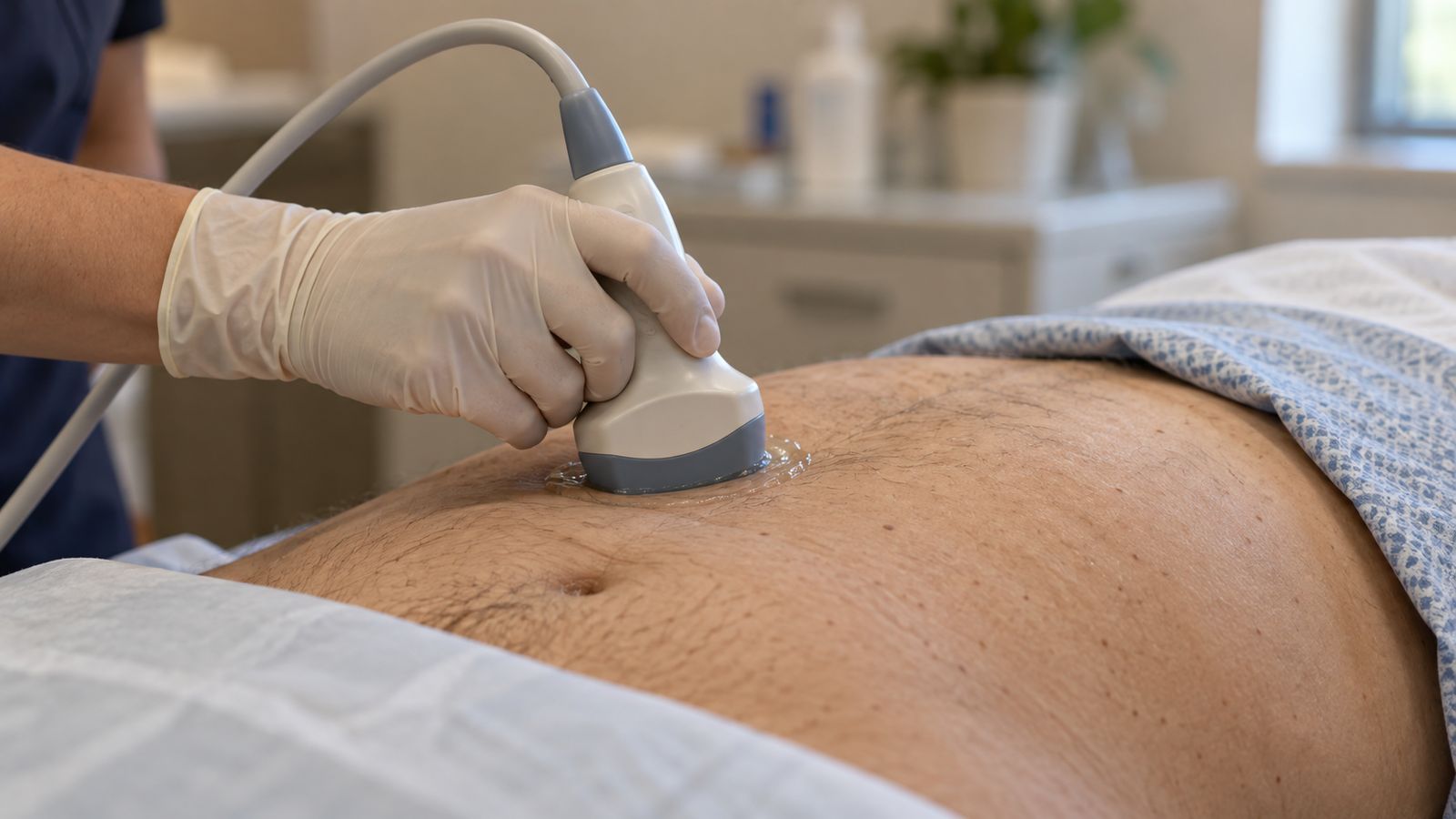
Screening is based on simple, painless and non-irradiant examination: ultrasound (Echo-Doppler) of the aorta. It is highly reliable for picking up an abdominal aneurysm, which makes it the test of choice. A CT scan (CT angiogram) is then used to map the anatomy before any operation.
Countries that screen do so in a targeted way. In the UK, all men are invited for an ultrasound scan in the year they turn 65, and the 2024 European guidelines reserve screening for people at risk. It is particularly useful in:
- men aged 65 to 75, smokers or former smokers;
- men aged 50 to 75 with a family history of aortic aneurysm.
The brothers, sisters and children of an affected patient have about twice the risk of the general population, even more when there is a bicuspid aortic valve or a connective tissue disease in the family. For the abdominal aorta, an ultrasound scan is enough; for the thoracic aorta, an echocardiogram or a CT scan provides the answer.
If you recognise yourself in any of these, raise it at a consultation: a single scan may be all it takes to settle the question. You will find the detail of the care we provide on our page aorta surgery.
Routture and dissection: the two complications feared
Two serious complications warrant the full attention to this disease:
- Breaking up : the wall gives way and causes massive internal bleeding. It is an emergency whose outcome depends on how fast treatment starts.
- The dissection : the wall of the aorta splits into layers, with blood forcing its way into the thickness of the wall. It typically announces itself with a sudden, tearing pain that is at its worst straight away.
The risk of rupture rises with the diameter of the aneurysm and with how fast it is growing. It is precisely to get ahead of these complications, before they happen, that monitoring and planned treatment make sense.
Read also: the signs of a cardiac emergency

Surveillance and surgical treatment
The strategy depends above all on the size of the aneurysm and how it changes. While it stays small, the approach is regular monitoring associated with risk factor correction (smoking cessation, blood pressure and cholesterol control).
| Diameter (abdominal aorta) | Routine conduct |
|---|---|
| 30 to 44 mm | Follow-up ultrasound every 12 months |
| 45 to 54 mm | Follow-up ultrasound every 3 months |
| 55 mm in men, 50 mm in women, or confirmed rapid growth | Discussion of an intervention |
These intervals are those of the UK screening programme; your doctor may adapt them. For the thoracic aorta, surgery is generally discussed from 55 mm, and earlier in the case of a genetic disease of the aorta or a bicuspid valve.
When intervention becomes necessary, two broad approaches exist:
Endovascular treatment (EVAR)
Minimally invasive technique performed by the arteries of the groin: an endoprosthesis is deployed inside the aorta to strengthen it, without opening the abdomen. It allows faster recovery and shorter hospitalization, at the cost of a lifetime monitoring by imaging. Minimally invasive.
Open surgery
The widened stretch of the aorta is replaced with a graft. It is the established operation, durable, and suited to certain anatomies. It falls within the expertise of open heart surgery and vascular surgery.
The choice between these techniques is made case by case, according to the anatomy of the aneurysm, your general health and your preferences.
Can you live a long time with an aortic aneurysm?
Yes, when it is known and monitored. A small aneurysm grows on average by about 2 mm a year: it takes on average six years for a 35 mm aneurysm to reach 55 mm, and a little over two years for a 45 mm aneurysm. Many patients live for years this way, with monitoring alone.
The real danger is rupture, which about 85% of people do not survive. A planned repair, carried out at the right time, carries a much lower risk. That is the whole logic of screening and monitoring: turning an often fatal emergency into a prepared operation.
Read also: 7 habits to protect your heart

Blood pressure, first lever
Each heartbeat exerts pressure on the dilated wall. The higher the blood pressure, the more this wall is pressed. Therefore, blood pressure control is not a detail of comfort but the main medical treatment of aneurysm under surveillance.
Three things matter more than the rest: taking your blood pressure medication without a break, stopping smoking, which directly speeds the aneurysm's growth, and avoiding sudden straining efforts such as lifting very heavy loads or intensive weight training. Moderate endurance exercise, by contrast, stays beneficial and is encouraged.
Do you have risk factors or have an aneurysm been detected? Do not wait for a symptom to appear. Dr Tber's practice in Tangier is there for screening, for monitoring and, if it comes to it, for the treatment that suits you best. Book an appointment Today to take stock in complete serenity.
Frequently asked questions
Does an aortic aneurysm hurt?
Can you live a long time with an aortic aneurysm?
What size should be operated on?
Is it serious to feel your aorta beating in your belly?
Do my kids have to be tested?
Can we do sports with an aneurysm under surveillance?
Sources and references
External resources, opened in a new tab.
- Abdominal aortic aneurysm NHS
- Abdominal aortic aneurysm screening NHS
- Abdominal aortic aneurysm screening: what you need to know NHS England
- 2024 guidelines on abdominal aortic aneurysm: key points Endovascular Today
- Growth rate of small aneurysms British Journal of Surgery
- Smoking and the risk of abdominal aortic aneurysm Scientific Reports
- 2024 guidelines on diseases of the aorta: key points American College of Cardiology
Readable also
On the blog
Infective endocarditis: when an infection attacks a heart valve, and the case of a 24-year-old patient operated on in Tangier
A badly treated sore throat, a dental procedure, a small wound: a bacterium enters the blood and settles on a heart valve. Endocarditis is rare, but it can destroy a valve in a few weeks. The warning signs, the treatment, and a case we published.
Read
Rheumatic heart disease: when a poorly treated sore throat damages the valves, and how to stop it
An untreated strep throat leads, three to six times out of a hundred, to an attack of acute rheumatic fever, and that attack can permanently damage a heart valve. It is the leading cause of valve surgery in Morocco, it mainly affects young women, and it is stopped by an injection every three weeks.
Read