

Severe aortic stenosis: symptoms, life expectancy and when to operate
Narrowing of the aortic valve progresses silently for years, then everything changes once the first symptoms appear. Understanding that turning point is understanding why the timing of the operation counts as much as the operation itself.
Written by Dr Mohamed el Amine Tber, cardiovascular surgeon in Tangier
The aortic narrowing, or aortic stenosis, is the commonest valve disease after sixty-five. What makes it disconcerting is that it progresses for years without showing anything, then the outlook shifts sharply the day the first symptoms arrive. Which is why the question is not only Do we have to operate?, but when.
Key figures
- 3 %
- About 3% of people over 75 have severe aortic stenosis, and 12% have aortic stenosis of any severity. Journal of the American College of Cardiology, 2013
- 1 in 2
- In patients too frail for surgery, half died within a year without valve replacement. PARTNER trial, New England Journal of Medicine, 2010
- 70 years
- This is the age from which the 2025 European guidelines favour TAVI when the anatomy is suitable; below that age, surgery remains recommended for low-risk patients. ESC and EACTS, 2025
- 15 to 20 years
- This is the usual lifespan of a biological valve; a mechanical valve lasts longer but requires anticoagulant treatment for life. NHS
The aortic valve in two sentences
The aortic valve is the heart's outlet door. With every beat it opens to let blood through into the aorta, then closes to stop it coming back. When it thickens and calcifies, that door no longer opens fully, and the heart has to push harder and harder to move the same amount of blood.
Why the valve shrinks
- Wear and calcification, by far the commonest cause, tied to age and to cardiovascular risk factors.
- Bicuspidia, a feature present from birth that affects about one person in a hundred: the valve has only two leaflets instead of three. It often shows up earlier, around the age of fifty or sixty, and is sometimes associated with widening of the aorta.
- The sequelae of acute joint rheumatism, a late consequence of streptococcal throat infections poorly treated in childhood. This cause is still with us in Morocco when it has all but vanished in Europe, and it affects younger patients.
The three symptoms that change everything
Three manifestations mark the turning point of the disease:
- Bleeding to effort, then to increasingly modest efforts;
- Pain in the chest to the effort, to the type of tightening;
- Unease or loss of consciousness, often at the effort.
The trap is that these signs are readily put down to age or being out of shape. Yet their arrival marks the shift from a disease you watch to a disease you have to treat. That is the most important message of this article: aortic narrowing that has become symptomatic should be taken care of without delay.
Severe aortic stenosis: how it is measured
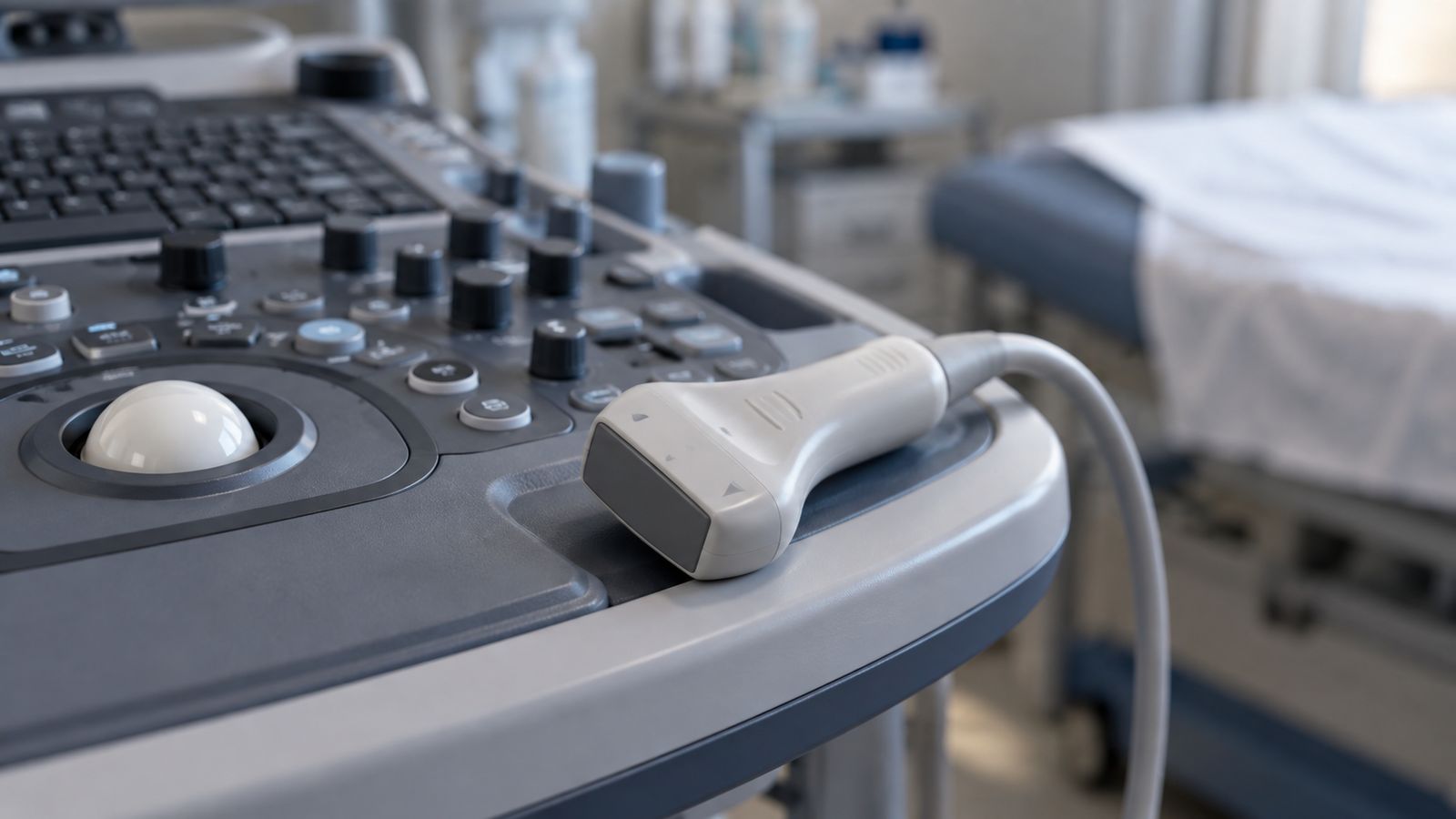
The echocardiogram is the central test. It measures how fast blood moves through the valve, the pressure difference either side of it, and how much opening is left. Those numbers grade the severity.
| Severity | Opening surface | Routine conduct |
|---|---|---|
| Light | Exceeding 1,5 cm2 | Spaced monitoring |
| Moderate | between 1.0 and 1.5 cm2 | Annual monitoring |
| Locked | 1.0 cm² or less | Specialized opinion, discussion of an intervention |
According to the European guidelines, aortic stenosis is called severe when the valve opening area is 1 cm² or less, with a mean pressure difference of at least 40 mmHg or blood flowing through at 4 metres per second or more. When these measurements do not agree, for example when the heart is pumping weakly, other tests settle the question.
A CT scan, a supervised exercise test or a coronary angiogram sometimes round out the work-up before the decision.
Life expectancy with aortic stenosis
As long as the narrowing remains mild or moderate and causes no symptoms, the immediate risk is low and the disease is monitored. Everything changes when it becomes severe and causes symptoms. In the PARTNER trial, in patients judged too frail for surgery, half died within a year with medical treatment alone, versus less than a third after valve implantation by TAVI.
Replacing the valve at the right time therefore changes the outlook. That is what monitoring is all about: acting before the heart is damaged, without operating too early.
When do we operate?
Two situations lead to a valve replacement:
- narrowing tight and symptomatic, whatever the age ;
- narrowing tight without symptom, but with objective signs that the heart is struggling: a fall in contraction strength, measurements worsening quickly, or symptoms brought out by an exercise test.
Conversely, a moderate, well-tolerated narrowing is not operated on. It is monitored, and that monitoring has value: it is what allows the operation to happen at the right moment rather than too late.
Replace valve: options
Surgical replacement
The diseased valve is removed and replaced with a prosthetic one. The operation is done through a conventional sternotomy or, in some cases, through a Minimally invasive route which reduces the size of the scar and the recovery time.
TAVI
The valve is deployed inside the old one, through the arteries, without opening the chest. This technique was first reserved for frail patients, then extended to others. The 2025 European guidelines favour it from the age of 70 when the valve has three leaflets and the anatomy is suitable, whereas surgical replacement remains recommended before 70 in low-risk patients. Age is always discussed as a team, together with anatomy, life expectancy and your preferences.
Read also: minimally invasive heart surgery, answers to your questions

Mechanical or biological
| Mechanical prosthesis | Biological prosthesis | |
|---|---|---|
| Life | Very long, in principle definitive | Limited, generally 15 to 20 years |
| Anticoagulant | Lifelong, with regular blood checks | Mostly not in the long run |
| Normal profile | Younger patient, biological monitoring accessible | Elderly patient, or wishing to avoid anticoagulant |
This is a choice to be discussed, not imposed. Your way of life, whether you can have regular blood tests, and any plan for a pregnancy weigh as heavily as your age.

After the intervention
After surgical replacement, recovery follows a pattern close to the one described in our guide to recovery after a bypass : about one week in hospital, getting up early, gradual rehabilitation and a return to activities within two to three months. After TAVI, the hospital stay is often two to three days.
Follow-up includes a baseline echocardiogram, then regular check-ups for life. Atrial fibrillation may appear afterwards or accompany the valve disease: it can be detected and treated.
Read also: normal or irregular heart rhythm, when to see a doctor
Did an ultrasound show a narrowing of your aortic valve? Dr Tber's practice in Tangier goes through your measurements, tells you exactly where you stand and whether the moment to operate has come. Book an appointment.
Frequently asked questions
What is severe aortic stenosis?
What is life expectancy with severe aortic stenosis?
Can we treat aortic narrowing with medication?
Should I operate if I have no symptoms?
Mechanical or biological prosthesis, which one to choose?
Does TAVI replace surgery?
Sources and references
External resources, opened in a new tab.
- 2025 guidelines on valvular heart disease: what changes EACTS
- 2021 guidelines on valvular heart disease European Society of Cardiology and EACTS
- PARTNER trial: TAVI in patients who cannot have surgery New England Journal of Medicine
- How common aortic stenosis is after 75 Journal of the American College of Cardiology
- Heart valve replacement: what happens NHS
- Aortic valve stenosis American Heart Association
Readable also
On the blog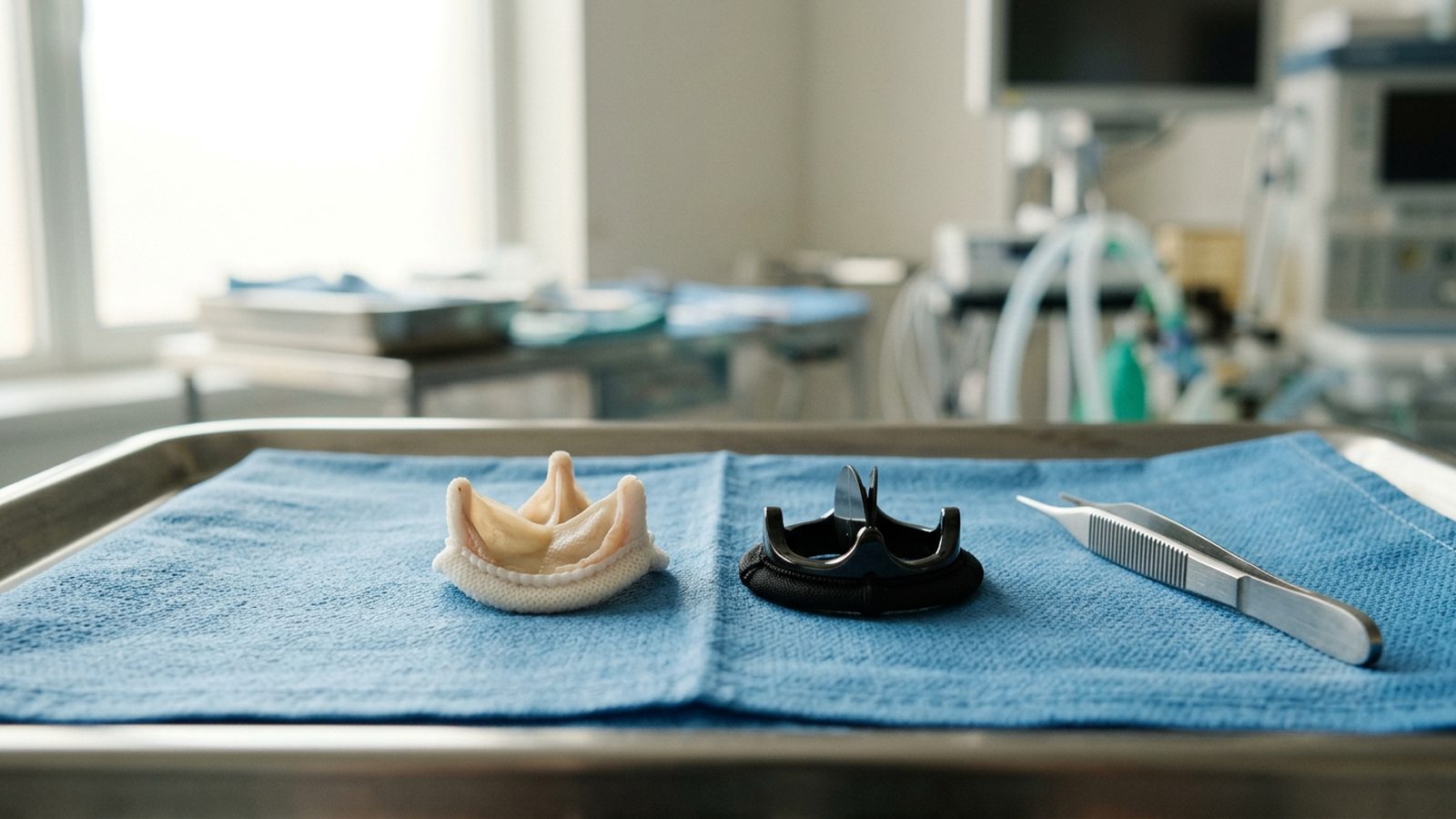
Heart valve replacement: how long the operation takes, biological or mechanical valve, success rate and cost in Morocco
A heart valve that no longer opens enough, or that leaks, ends up wearing the heart out. When medicines are no longer enough, it is replaced. What happens in the operating room, the choice between a biological and a mechanical valve, the real risks, recovery and the cost in Morocco.
Read
Infective endocarditis: when an infection attacks a heart valve, and the case of a 24-year-old patient operated on in Tangier
A badly treated sore throat, a dental procedure, a small wound: a bacterium enters the blood and settles on a heart valve. Endocarditis is rare, but it can destroy a valve in a few weeks. The warning signs, the treatment, and a case we published.
Read