

Rheumatic heart disease: when a poorly treated sore throat damages the valves, and how to stop it
An untreated strep throat leads, three to six times out of a hundred, to an attack of acute rheumatic fever, and that attack can permanently damage a heart valve. It is the leading cause of valve surgery in Morocco, it mainly affects young women, and it is stopped by an injection every three weeks.
A sore throat in childhood, missed or poorly treated. A few weeks later, a fever and swollen joints. Then nothing at all for years. And one day, at twenty-five or thirty, breathlessness climbing the stairs, a pregnancy that runs into trouble, or a murmur picked up by chance. That is the path of rheumatic heart disease, and it is today the leading reason for operating on a valve in Morocco.
Key figures
- 3 to 6%
- Risk of acute rheumatic fever in a child after an untreated strep throat. Less than 0.2% if it is properly treated. Ministère de la Santé, national guide 2026
- 60 %
- Of cases involve the mitral valve, 20% the aortic valve, and one time in three several valves at once. Ministère de la Santé, national guide 2026
- 17
- Injections a year, that is one every three weeks: this is the schedule that stops the disease coming back. National strategic plan 2026-2030
- 55 million
- People are living with rheumatic heart disease worldwide, and it causes about 360,000 deaths a year. World Health Organization, 2021
What "rheumatic heart disease" means
The name raises a smile, because we associate the word rheumatism with joint pain in older people. This is something else. After a throat infection caused by one particular bacterium, group A streptococcus, the immune system builds defences against the germ. The problem is that some parts of this bacterium resemble human body tissue, in particular a protein in the heart muscle. The defences then aim at the wrong target and attack the heart, the joints, and sometimes the brain and the skin as well. Doctors call this molecular mimicry.
This attack has a name, acute rheumatic fever. It mainly affects children aged 5 to 15. And it leaves a very uneven mark depending on the organ: the joints swell, they hurt, then they heal without any lasting damage. The Ministère de la Santé puts it bluntly in its national guide: the only permanent lesion is the heart lesion.
When this heart involvement persists, it is called rheumatic heart disease. The valves of the left heart are the most exposed: the mitral valve in 60% of cases, the aortic valve in 20%, and several valves at once one time in three.
From a sore throat to a damaged valve
The chain is short and well described. The throat infection first. Then, usually two to three weeks later according to the Moroccan guide, within a range of one to five weeks according to American and British sources, the attack of acute rheumatic fever: fever, joint pain that moves from one joint to another, sometimes inflammation of the heart, and more rarely abnormal uncontrolled movements called chorea. Finally, years later, the valve becomes narrowed or leaks.
One figure sums up what is at stake, and it comes from the Moroccan ministry: after an untreated streptococcal infection, the risk of developing acute rheumatic fever is 3 to 6% in children, whereas it falls below 0.2% if the infection has been properly treated. A sore throat treated as it should be means thirty times less risk.
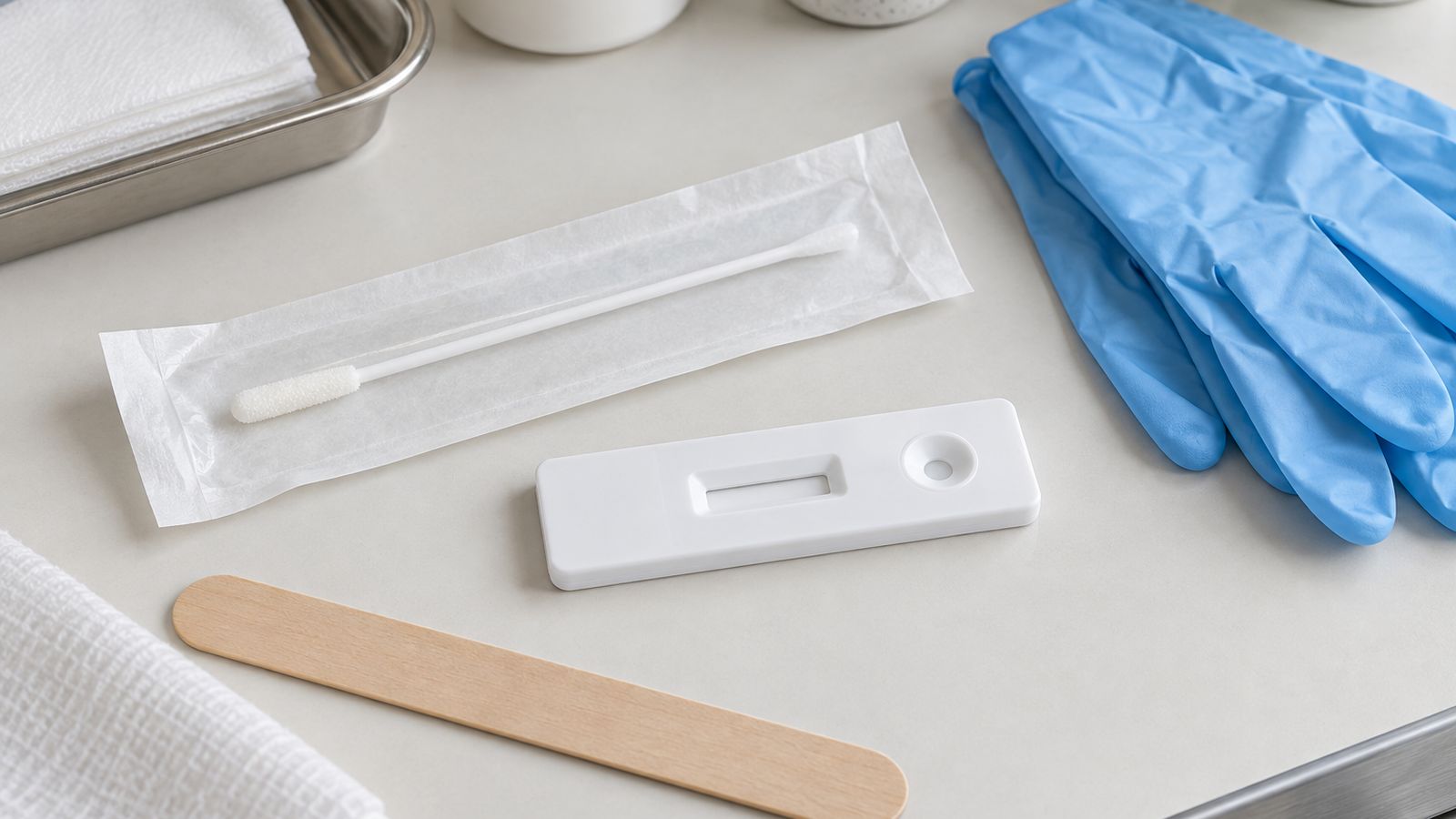
But it is the right sore throat that has to be treated. Most are viral and clear up on their own: Assurance Maladie puts viral forms at 60 to 75% in children, and 75 to 90% in adults. No single sign taken on its own allows the two to be told apart by eye, and the World Health Organization is categorical on this point. That is the job of the rapid test, done with a swab in a few minutes. When it is not available, the World Health Organization recommends, in countries at moderate to high risk such as Morocco, treating the child or adolescent as soon as strep throat is clinically suspected. The reference treatment remains penicillin, either a single injection or ten days of oral treatment, the full course being essential.
What is gained by doing this has been measured. A Cochrane review covering 18 studies and more than 12,000 participants shows that antibiotics clearly reduce the risk of acute rheumatic fever. The same review points out that 82% of untreated sore throats get better within a week: that is why the aim is not to treat everything, but to spot the ones that matter.
Read also: the signs of a cardiac emergency and how to react in Tangier
Recognising the attack in a child
The diagnosis rests on an international framework, the Jones criteria, revised in 2015. One technical point here has a very concrete consequence for Moroccan families: these criteria are broader in countries where the disease is common. A single affected joint is enough to count, where several would be needed in a low-risk country, and the thresholds for fever and for inflammation in the blood are lower. The Moroccan ministry explicitly applies this version, and its table is in fact headed "Jones criteria adapted to a high-risk setting (Morocco)". In other words, a doctor in Morocco has to think of this disease sooner than a doctor in Europe.
During a first attack, joint involvement is the most common symptom. Heart involvement, for its part, occurs in half to two thirds of cases, and it is the only one that leaves a mark. Chorea, those involuntary movements of the face and the limbs, affects 10 to 30% of children, more often girls, and can appear several months after the infection.
The Moroccan guide also warns against the opposite excess, and its warnings deserve to be known by parents: a high ASO titre on a blood test is not enough to make the diagnosis, no laboratory value is a criterion on its own, and joint pain that lasts beyond four weeks is not acute rheumatic fever. This is not a detail: a diagnosis made carelessly condemns a child to years of pointless injections.
The trap: one third of patients never had a sore throat
This is the sentence that most disconcerts families. At least one third of cases of acute rheumatic fever follow streptococcal infections that are very mild or cause no symptoms at all, and that never prompted anyone to see a doctor. The American learned societies find the same proportion of patients who remember no sore throat at all.
The same silence is found later on. Recurrences, the ministry writes, can progress quietly, alerting neither the patient nor those around them, while the valve damage forms or worsens. That is why prevention does not rest on what you feel, but on a schedule that is kept and an echocardiogram when it is indicated.
What an adult feels, ten or twenty years later
In Western countries, the textbooks describe a latency of twenty to forty years between the initial infection and the first symptoms. The World Health Organization notes that the disease progresses much faster in developing countries, where symptoms can appear as early as late adolescence or the early twenties. That is the most important point to take away here: in Morocco, the silent phase is shorter than in Europe.
When the symptoms do come, they often look like ordinary tiredness:
- Breathlessness on exertion, then on smaller and smaller efforts.
- Unusual tiredness, a drop in stamina.
- Palpitations, sometimes established atrial fibrillation.
- More rarely, phlegm streaked with blood.
- Swollen ankles, a discomfort in the chest.
The trap is that many patients complain of nothing because they have cut back their activity without noticing, year after year. The learned societies describe it in black and white: in low- and middle-income countries, more than half of affected patients have no memory of an attack of rheumatic fever and discover the disease during a pregnancy, an episode of heart failure or a stroke.

The injections every three weeks, the step that stops the disease
Once the attack is over, everything depends on preventing recurrences, because every new flare can damage the valves a little more. The treatment amounts to an intramuscular injection of benzathine penicillin, a slow-release penicillin.
In Morocco, the schedule is one injection every three weeks, that is seventeen injections a year, as the national plan sets out. This is not an isolated local choice: the World Health Organization describes exactly the same strategy for areas where the disease is common, the four-week interval being reserved for low-risk countries and low-risk patients. The dose is 600,000 units up to 30 kg, and 1.2 million units above that.
The duration depends solely on whether the heart was affected, and the Moroccan protocol sums it up in three lines:
- Acute rheumatic fever without heart involvement: five years.
- Heart involvement that healed without lasting damage: ten years.
- Valve left damaged: for life.
The international recommendations add an age floor, for example up to 18, 21 or 25 years depending on the situation, and point out that the duration is discussed case by case. One point is constant everywhere: after valve surgery, prophylaxis continues for life, because a prosthetic valve does not protect against a new attack of rheumatic fever.
That leaves the real reason why families give up: the pain of the injection. The national plan itself lists it among the causes of poor adherence. The Moroccan guide devotes two pages to reducing it, and these steps are worth knowing and worth asking for: lidocaine injected just before, in a separate syringe, the syringe warmed between the hands, a needle of the right gauge, a slow injection over two to three minutes into the upper outer quadrant of the buttock, no massage afterwards, an ice pack, a quarter of an hour lying down and half an hour of observation, then walking.
As for the risk of allergy, it deserves an answer with a figure rather than rumours: the ministry puts it at less than 0.012% per injection, and notes that it does not increase over the years of treatment. Conversely, the adherence target is set at at least 80% of injections given over twelve months for a patient to be considered protected.

Pregnancy and a narrowed mitral valve: the question to ask beforehand
This is the chapter that most directly concerns Moroccan patients, because this disease affects women more, and because it often comes to light at the time of a pregnancy.
During pregnancy, the output of the heart increases, and the pressure across a narrowed valve rises by about 50%, especially between the first and the second trimester. The European figures are clear: heart failure occurs in one woman in three when the mitral valve area is less than or equal to 1.0 cm², and in one woman in two at 1.5 cm² or less, even in patients who had no symptoms before the pregnancy. The fetal side counts too, with 20 to 30% of preterm births and 5 to 20% of growth restriction.
Hence a recommendation that changes a life: mitral stenosis below 1.5 cm² must be corrected before a pregnancy is advised, even in the absence of symptoms, and balloon dilatation is then the first option to consider. Severe stenosis is a contraindication to pregnancy. The Moroccan guide says the same thing in its own words: ideally, women with rheumatic heart disease should be identified and assessed before conception, and any breathlessness occurring during a pregnancy should lead promptly to a cardiac assessment.
One reassuring detail, often a source of needless worry: penicillin carries no risk for the fetus and the injections must be kept up during pregnancy.
Treating a damaged valve
Let us start with what does not work, because it is what many people hope for. No medicine reopens a narrowed valve. Diuretics, beta blockers and the other treatments ease the breathlessness and slow the heart, they do not repair the valve.
The question that comes up most often is treatment without surgery. The honest answer is: yes, in certain specific cases. A narrowed mitral valve can be reopened with a balloon passed up on a catheter, without opening the chest. The 2025 European recommendations make it a first-line treatment when the anatomy is suitable, that is to say a valve that is still supple, barely calcified, with no significant involvement of the apparatus beneath the valve.
This procedure has firm limits, and knowing them avoids false hopes. It is not possible if the valve leaks more than very slightly, if it is heavily or doubly calcified, if there is a clot in the left atrium, if there is no commissural fusion to reopen, or if another valve has to be operated on at the same time. Put plainly: the balloon reopens a valve that is stuck together, it does not repair a valve that leaks. And the narrowing can come back over the years, which calls for regular follow-up with echocardiography, even when you feel well.
When the balloon is not possible, surgery takes over, either repairing the valve or replacing it. The choice of prosthesis is open to discussion, all the more so here because the patients are young: a mechanical valve lasts longer but requires an anticoagulant for life, whereas a woman who is considering a pregnancy should avoid a mechanical valve because of the risks linked to anticoagulant treatment. This decision is taken with the surgeon, according to your plans in life, not by an automatic rule.
Read also: open-heart surgery, how long it takes and what to expect afterwards
Palpitations, stroke, and the trap of the new anticoagulants
A narrowed mitral valve makes the left atrium enlarge, and a dilated atrium often ends up beating chaotically: this is atrial fibrillation. First in episodes, then permanently. With it, the risk of a clot rises sharply. Among acquired valve conditions, mitral stenosis is the one that carries the highest risk of embolism, and well-managed anticoagulation brings that risk down dramatically.
Then comes the question that almost every patient asks: can the regular blood tests be replaced by one of the new anticoagulants, which are simpler to take? In this particular disease, the answer is no. The 2025 European recommendations explicitly rule out direct oral anticoagulants when the mitral valve area is less than or equal to 2.0 cm², as well as in the presence of a mechanical valve. The reason is not theoretical: the INVICTUS trial, conducted in 4,531 patients with rheumatic heart disease, found more strokes and more deaths on rivaroxaban than on standard treatment. Regular monitoring of the INR is therefore not an outdated habit, it is what protects you.
Morocco has set itself a target for 2030
In September 2026 the Ministère de la Santé et de la Protection Sociale published a national strategic plan for the prevention and control of acute rheumatic fever and rheumatic heart disease for 2026-2030, together with a national clinical guide for healthcare staff. Both documents are public.
What they say about the situation: the country falls into a zone of moderate to high prevalence, and in 2024, 5,306 new cases of acute rheumatic fever and 1,754 new cases of rheumatic heart disease were notified. The ministry itself attaches to these figures a caveat that has to be quoted alongside them: because the diagnosis often rests on clinical and laboratory findings rather than on echocardiography, its notification data probably overstate reality, perhaps by a factor of three. Acknowledging that limit is worth more than brandishing a figure.
What they are aiming for is more telling still. The plan sets out to bring the incidence in school-age children below the threshold of 2 per 100,000 and the prevalence of rheumatic heart disease below 1 per 1,000 inhabitants by 2030. These two numbers are not chosen at random: they are exactly the thresholds that define, internationally, a low-risk population. Morocco has therefore officially set itself the objective of leaving the category of countries at moderate to high risk.
To do this the plan provides for rolling out rapid sore throat tests everywhere, for making sure the injections are available, and for adding echocardiographic screening for rheumatic heart disease to the school medical check-up. It also puts a figure on the cost of inaction: about 27,000 dirhams a year to care for an affected patient, and 100,000 dirhams for valve surgery.
When to see a doctor, and when it is urgent
Book an appointment, not as an emergency but without waiting months, in these situations:
- Fever, joint pain or breathlessness in the weeks following a sore throat, especially in a child aged 5 to 15.
- Repeated breathlessness on exertion, unusual tiredness, palpitations, swollen ankles.
- A heart murmur noted during an examination, even with no symptoms at all: it warrants an echocardiogram.
- Breathlessness during a pregnancy, which should lead promptly to a cardiac assessment.
- A planned pregnancy in a woman who is being followed up for a valve problem: the consultation happens before, not after.
Call the emergency services without waiting, 141 for the SAMU or 15 for Civil Protection, if there is sudden breathlessness that stops you speaking, chest pain that lasts, or signs of a stroke such as difficulty speaking, weakness in one arm or a drooping face.
Two final points, often overlooked. The first concerns the teeth: good oral hygiene is part of the treatment, because a damaged valve or a prosthetic one is exposed to infection. The second is a common confusion: the injection every three weeks protects against recurrences of rheumatic fever, it does not protect against endocarditis. Before dental treatment, what is needed is specific antibiotic prophylaxis, and it is prescribed separately.
Dr Tber, a cardiovascular and thoracic surgeon in Tangier, looks after these valves with his team at the Clinique Riad Marshan, from assessment at a consultation through to surgery when it becomes necessary. An echocardiogram and an expert opinion are worth more than worry that drags on.
Read also: severe aortic stenosis, symptoms and when to operate
Frequently asked questions
What is rheumatic heart disease?
Is rheumatic heart disease dangerous?
Should every sore throat be treated with an antibiotic?
How long do the penicillin injections last?
Does the injection hurt, and is it dangerous?
Can a heart valve be treated without surgery?
Can you have a child with a narrowed mitral valve?
Can the new anticoagulants replace the regular blood test?
Is acute rheumatic fever contagious?
Sources and references
External resources, opened in a new tab.
- National guide to the diagnosis and management of acute rheumatic fever and rheumatic heart disease, 2026 edition Ministère de la Santé et de la Protection Sociale du Royaume du Maroc
- National Strategic Plan for the Prevention and Control of Acute Rheumatic Fever and Rheumatic Heart Disease 2026-2030 Ministère de la Santé et de la Protection Sociale, direction de l'épidémiologie
- WHO guideline on the prevention and diagnosis of rheumatic fever and rheumatic heart disease, 2024 World Health Organization
- Rheumatic fever and rheumatic heart disease, report of an expert consultation (Technical Report Series 923) World Health Organization, 2004
- Rheumatic heart disease, fact sheet World Health Organization, January 2025
- Revision of the Jones Criteria for the Diagnosis of Acute Rheumatic Fever in the Era of Doppler Echocardiography American Heart Association, Circulation 2015
- 2025 Guidelines for the management of valvular heart disease European Society of Cardiology and EACTS
- 2018 Guidelines for the management of cardiovascular diseases during pregnancy European Society of Cardiology, European Heart Journal
- Rivaroxaban in Rheumatic Heart Disease-Associated Atrial Fibrillation, INVICTUS trial (4,531 patients) New England Journal of Medicine 2022, American College of Cardiology summary
- Antibiotics for sore throat, systematic review (18 studies, 12,249 participants) Cochrane, 2021
- Sore throat: definition, symptoms and diagnosis Assurance Maladie (ameli.fr), September 2026
- Acute Rheumatic Fever, clinical guidance Centers for Disease Control and Prevention, August 2025
- Rheumatic fever, patient information NHS, January 2025
Readable also
On the blog
Aortic aneurysm: understanding a silent disease, and getting screened for it in Tangier
An aortic aneurysm often develops without a single sign, until it becomes dangerous. Understanding what causes it, how it is screened for and how it is treated is what lets you act in time, and calmly.
Read
Blocked artery in the leg: calf pain when walking, the tests, stent or bypass
Calf pain that always appears after the same distance and goes away within a few minutes of rest is the first sign of a blocked artery in the leg. Here is how the diagnosis is made, what it says about your heart, and when an operation is genuinely discussed.
Read