

Mechanical or biological valve: how to choose the valve that will stay with you for life
A mechanical valve lasts a lifetime but means taking an anticoagulant every day. A biological valve avoids this treatment but wears out in ten to fifteen years. Between the two, your age, plans for pregnancy, your job and access to regular blood tests make the difference. Here are the criteria, one by one.
Written by Dr Mohamed el Amine Tber, cardiovascular surgeon in Tangier
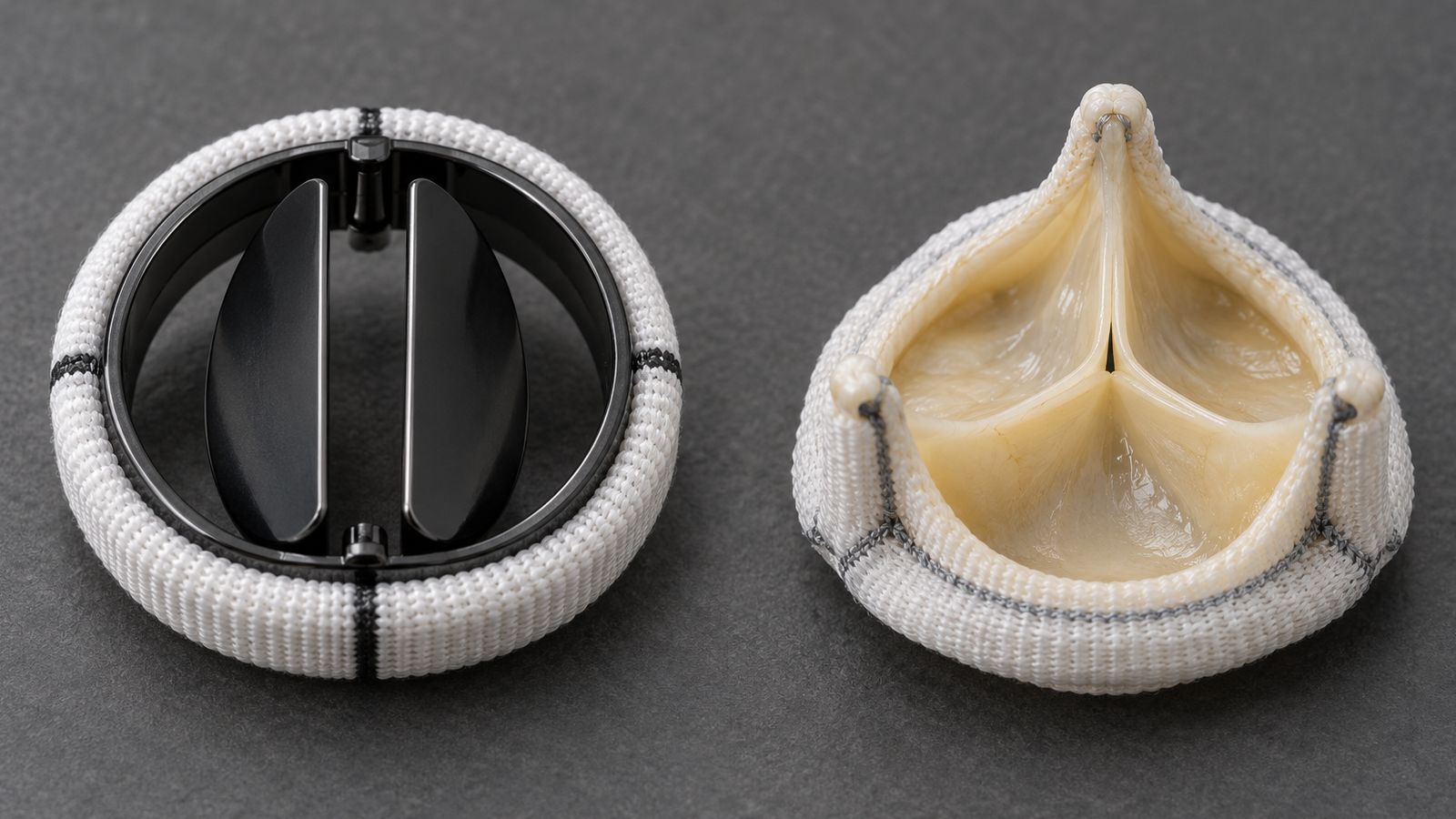
When a heart valve needs replacing, one question comes up at every consultation: mechanical or biological? It is not a matter of quality, as both valves work very well. It is a choice between two different constraints, and the right answer depends on you: your age, your plans in life, your job, and how easily you will be able to have your blood checked for years to come. Here is how we decide, together, before the operation.
The two valves in brief
- Mechanical
- Pyrolytic carbon, designed to last a lifetime. In return, an anticoagulant every day, for life, with regular blood tests.
- Biological
- Treated animal tissue, from cattle or pigs. No long-term anticoagulant in most cases, but it wears out in ten to fifteen years on average.
The mechanical valve: strong for life, with treatment for life
A mechanical valve does not wear out. Fitted at 40, it has every chance of still working at 80. That is its great advantage: in principle, no second operation for the valve.
Its constraint is the blood. Blood tends to clot on contact with the valve, and a clot can block it or travel to the brain. So you need to take an anticoagulant every day from the vitamin K antagonist family, most often acenocoumarol (Sintrom) in Morocco, and check regularly with a blood test that your blood is “thin enough, but not too thin”. This measurement is called the INR. Your target is set for you according to the type and position of the valve and your other risk factors, most often between 2.5 and 3.5.
- The newer anticoagulants, the ones that do not need blood tests, must not be used with a mechanical valve. There is currently no alternative to monitoring the INR.
- An INR that is too low puts you at risk of a clot on the valve; too high, at risk of bleeding. A regular diet and telling your doctor about any new medicine help keep it stable.
- Many patients hear the valve’s soft “click”, especially at night. You get used to it within a few weeks.
The biological valve: no lifelong treatment, but a limited lifespan
A biological valve is made from treated animal tissue. It looks like a natural valve and blood clots on it very little. After the operation, treatment for a few weeks to three months is usually enough, and then it is stopped, unless there is another reason to continue it, such as an irregular heart rhythm (atrial fibrillation).
Its limit is time. The tissue stiffens and wears: ten to fifteen years on average, longer when it is fitted after the age of 65, less in a young patient. When it wears out, it has to be replaced, either by a new operation or, more and more often, by a valve slid inside the old one through a catheter, without reopening the chest. This second option depends on the size of the first valve: one more reason to choose it carefully from the start.
Read also: heart valve replacement, length of the operation, risks and recovery
Age, the first criterion
The European cardiology and cardiac surgery guidelines, published in 2021, give age benchmarks:
- under 60 for the aortic valve, and under 65 for the mitral valve, a mechanical valve is generally preferred, because a biological valve would wear out too soon;
- over 65 for the aortic valve, and over 70 for the mitral valve, a biological valve is generally preferred, because it has a good chance of lasting the rest of your life, without an anticoagulant;
- in between, there is no single right answer: we weigh up the other criteria below, and your preference counts.
These are benchmarks, not rules. A 55-year-old patient who will not be able to monitor their INR may receive a biological valve; a 68-year-old patient who already takes an anticoagulant for another reason may receive a mechanical valve.
The other criteria that tip the balance
Plans for pregnancy
For a young woman who still wants children, the question is a delicate one. Pregnancy with a mechanical valve is possible, but it is high risk: vitamin K antagonists can harm the baby, especially in the first trimester, and changing treatment during pregnancy increases the risk of a clot on the valve. For this reason, a biological valve is often discussed, accepting that it will have to be replaced later.
INR monitoring where you live
This is a criterion that is too often forgotten, and it matters a great deal for patients who come from far away. A mechanical valve means having a laboratory nearby, a blood test every few weeks, and a doctor who adjusts the dose. If you are going back to a town where this follow-up is difficult, in Morocco or in your home country, a biological valve may be safer. There are also finger-prick devices for measuring your own INR, which make life much easier once you have learned to use them.
Your job and your activities
An anticoagulant puts you at risk of bleeding after a knock or a fall. For someone who plays contact sports, a construction worker who works at height or a person who falls often, this risk weighs in the balance.
An anticoagulant you already need
If you already have atrial fibrillation or another reason to take an anticoagulant for life, the main advantage of the biological valve partly disappears. The mechanical valve then becomes attractive again, especially in a patient who is still young.
Rheumatic heart disease
In Morocco and in Africa, many patients who have valve surgery are young and had rheumatic fever in childhood. For them, age points towards a mechanical valve, but we also need to look at whether the valve can be repaired rather than replaced.
Read also: rheumatic heart disease, from a poorly treated sore throat to a damaged valve

What if we could keep your own valve?
Before choosing between two artificial valves, I always check whether your valve can be repaired. This is often possible for a leaking mitral valve: we reshape it, reinforce it with a ring, and you keep your own valve, with no lifelong anticoagulant and no built-in wear. When repair is feasible and durable, it is generally the best solution. The choice between mechanical and biological only arises if it is not.

How we decide, together
The choice is made in consultation, before the operation, with your test results in front of us. I explain what each valve would change for you, in practical terms, in your everyday life and in fifteen years’ time. You tell me what matters to you: not going back on treatment, not having another operation, plans for a child, a return to your home country. There is no wrong decision when it is an informed one, and that is the one we will go with.
When to consult
Book an appointment if you have been told you need valve surgery and you are hesitating between the two types, if you have a biological valve fitted more than ten years ago and your breathlessness is coming back, or if you would like a second opinion before deciding. Dr Tber, a cardiovascular surgeon in Tangier, reviews your test results, explains the options, including repair when it is possible, and operates on you at the Clinique Riad Marshan when necessary.
Frequently asked questions
At what age is a biological valve chosen?
How long does a biological valve last?
Can Sintrom be replaced by a modern anticoagulant with a mechanical valve?
Can a woman with a mechanical valve have a child?
What happens when a biological valve wears out?
Sources and references
External resources, opened in a new tab.
- 2021 ESC/EACTS Guidelines for the management of valvular heart disease European Society of Cardiology and EACTS, European Heart Journal 2022
- Aortic valve replacement, patient information NHS, 2023
- Heart valve surgery, patient information American Heart Association
Readable also
On the blog
Open-heart surgery: how long it lasts, what really happens, and life afterwards
Three to six hours in the operating theatre, about a week in hospital, six weeks for the breastbone to knit back together. Here is exactly how an open-heart operation unfolds, why the only success rate that counts is the one calculated for you, what makes cardiac surgery in Morocco different, and the signs that should bring you back to hospital after you go home.
Read
Having heart surgery in Morocco when you come from elsewhere in Africa: how much to budget for the operation, the stay and the journey
A heart operation in Tangier costs between 70,000 and 150,000 DH depending on the procedure, or about 6,400 to 13,600 euros. For a patient coming from Senegal, Côte d'Ivoire, Cameroon or elsewhere, you also need to add the journey, the stay and the person accompanying you. Here is the full budget, item by item.
Read