

Heart valve replacement: how long the operation takes, biological or mechanical valve, success rate and cost in Morocco
A heart valve that no longer opens enough, or that leaks, ends up wearing the heart out. When medicines are no longer enough, it is replaced. What happens in the operating room, the choice between a biological and a mechanical valve, the real risks, recovery and the cost in Morocco.
Written by Dr Mohamed el Amine Tber, cardiovascular surgeon in Tangier
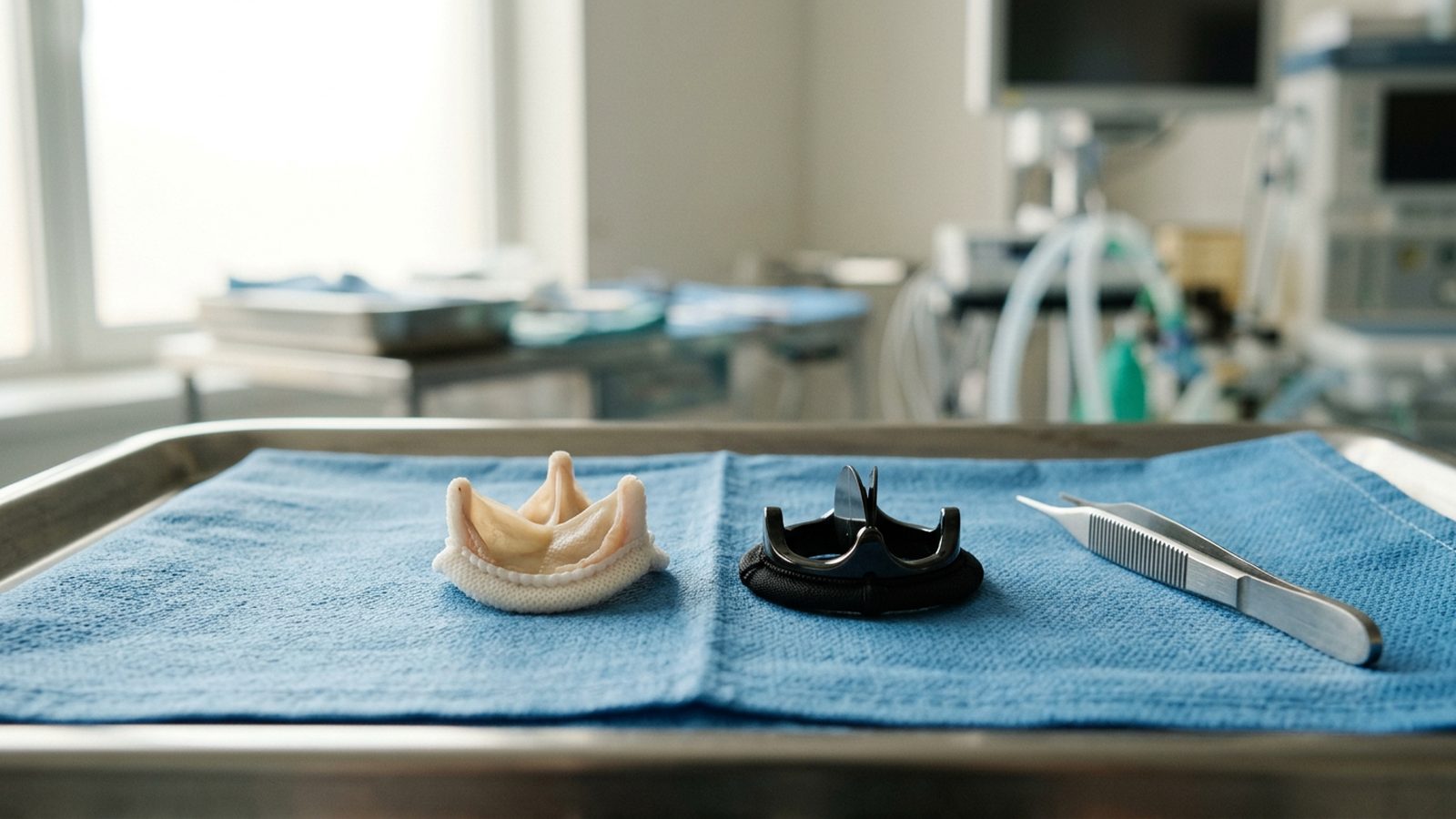
A heart valve that no longer opens enough, or that leaks, ends up wearing the heart out. When medicines are no longer enough, it is replaced. Here, without jargon, is what you need to know before this operation: what happens in the operating room, the choice of valve, the real risks, recovery and what it costs in Morocco.
When does a valve need replacing?
The heart has four valves. The two that wear out most often are the aortic valve and the mitral valve. Two problems lead to surgery.
- Narrowing: the valve calcifies and opens poorly. The heart pushes against a half-closed door. This is the most common case after 65, and earlier in people born with a valve that has two leaflets instead of three, the bicuspid valve.
- Leakage: the valve no longer closes and part of the blood flows backwards. In Morocco, childhood rheumatic fever remains a major cause of leakage or narrowing of the mitral valve.
We operate when the valve is severely affected and the patient has symptoms, breathlessness, chest pain, faintness on exertion, or when the heart starts to enlarge even without symptoms. Waiting too long damages the heart muscle permanently.
Read also: severe aortic stenosis, symptoms, life expectancy and when to operate
How long does the operation take?
The procedure itself takes between two and a half and four hours. It is done under general anaesthesia, with the heart stopped, using a machine that replaces the heart and lungs while I work on the valve: cardiopulmonary bypass. The actual time the heart is stopped is much shorter, usually one to one and a half hours.
Depending on the valve and your anatomy, the approach is either the classic opening of the breastbone or a minimally invasive incision of a few centimetres between two ribs. The valve implanted is the same; what changes is the scar and the speed of recovery.
Read also: open-heart surgery, how long it takes and what awaits you afterwards

Biological or mechanical valve: which one to choose?
This is the most important decision, and we make it together before the operation.
The two valves in brief
- Biological
- Treated animal tissue, bovine pericardium or porcine valve. Lasts ten to fifteen years, longer after 65. Aspirin, sometimes an anticoagulant for three months. Silent. Pregnancy possible.
- Mechanical
- Pyrolytic carbon, two leaflets. Lasts a lifetime. Daily anticoagulant for life with regular blood tests. A faint click audible in a quiet room. Pregnancy difficult.
- Under 60
- The 2021 European guidelines favour the mechanical valve for the aortic valve, and under 65 for the mitral valve.
- Over 65
- The biological valve becomes the first choice, with a grey zone between 60 and 65 depending on each person's life.
The rule adapts to each life. A fisherman, a thirty-year-old woman who wants children, a patient who lives far from a laboratory for blood tests will not get the same answer. My role is to give you both scenarios over twenty years, not a single option.
What is the success rate?
For an isolated aortic valve replacement, in a patient operated on at the right time, the risk of death linked to the operation is around one to three percent in large international series. It rises if the heart is already very weak, if several procedures are combined, bypass and valve for example, or if the valve is infected. That is why the date of the operation matters as much as the operation itself.
The complications we watch for are well known: bleeding, rhythm disturbance, often a temporary atrial fibrillation, infection, stroke. They are anticipated, and that is the role of intensive care in the first forty-eight hours.

Recovery, step by step
- Day 0 to 2: intensive care. You are up on your feet the next day.
- Day 2 to 7: ward, walking in the corridor, breathing physiotherapy. Discharge usually between the sixth and eighth day.
- Weeks 1 to 4: normal tiredness, daily walking, no lifting. The breastbone takes six to eight weeks to heal.
- Weeks 4 to 8: back to driving, office work and social life.
- Month 3: check-up echocardiogram. Most patients say they breathe as they did before the illness.
With a mechanical valve, you go home with your anticoagulant record and a monthly blood test once the balance is found. With a biological valve, follow-up is one echocardiogram a year.
How much does it cost in Morocco?
A valve replacement sits at the upper end of cardiac surgery costs, because the prosthesis itself is expensive: expect between 90,000 and 150,000 dirhams all inclusive in a clinic, depending on the valve chosen, the length of intensive care and any associated procedures.
For CNSS members, cardiac surgery is one of the long-term conditions covered at 100% after prior approval, and the approved clinic is paid directly by the fund. You do not advance the costs.
Read also: how much heart surgery costs in Morocco and how the CNSS covers it
And TAVI, the valve without opening the chest?
TAVI consists of placing an aortic valve through the artery in the leg, without opening the chest. It is an excellent option for elderly or frail patients for whom the classic operation would be too risky. In a younger patient in good condition, surgery remains the reference, because the surgical valve lasts longer and its future at twenty years is known. If TAVI is the right solution for you, I will tell you and refer you to the team that performs it.
When to consult
Make an appointment if a cardiologist has told you about a narrowed or leaking valve, if a murmur has been heard, if you are breathless on efforts that did not bother you before, or if an operation has been proposed and you want a second opinion. Dr Tber, cardiovascular surgeon in Tangier, reviews your tests, explains the two valve options and operates at the Riad Marshan Clinic when necessary.
Frequently asked questions
How long does heart valve surgery take?
How long does a biological valve last?
Can you live normally with a mechanical valve?
Does the CNSS cover valve replacement?
Do you need a cardiologist or a surgeon to decide?
Sources and references
External resources, opened in a new tab.
- 2021 ESC/EACTS Guidelines for the management of valvular heart disease Société européenne de cardiologie et EACTS, European Heart Journal 2022
- List of long-term conditions and serious, costly conditions (ALD/ALC) National Social Security Fund (CNSS)
- Aortic valve replacement, information patient NHS, 2023
- Heart valve surgery, information patient American Heart Association
Readable also
On the blog
Rheumatic heart disease: when a poorly treated sore throat damages the valves, and how to stop it
An untreated strep throat leads, three to six times out of a hundred, to an attack of acute rheumatic fever, and that attack can permanently damage a heart valve. It is the leading cause of valve surgery in Morocco, it mainly affects young women, and it is stopped by an injection every three weeks.
Read
Having heart surgery in Morocco when you come from elsewhere in Africa: how much to budget for the operation, the stay and the journey
A heart operation in Tangier costs between 70,000 and 150,000 DH depending on the procedure, or about 6,400 to 13,600 euros. For a patient coming from Senegal, Côte d'Ivoire, Cameroon or elsewhere, you also need to add the journey, the stay and the person accompanying you. Here is the full budget, item by item.
Read